
You’re not building a brand. You’re feeding an algorithm.

Aesop case study and why the most powerful brand strategy available to scaling beauty and wellness founders isn't a campaign.
Let's start with a provocation.
You have spent the last three years building a content engine. You have a posting calendar. You have a UGC strategy. You have an influencer tier, micro, macro, and one mega, who did that one story that drove 4,000 clicks but zero retention. You have repurposed, reformatted, and refreshed. You have hired a social media manager and then a second one. And somewhere between your 847th caption and your brand's fourth "core aesthetic," something quietly happened: your brand stopped meaning anything.
This is not a failure of effort. It is a failure of architecture.
Aesop, the Melbourne-born skincare brand acquired by L'Oréal in 2023 for $2.5 billion, built one of the most valuable brand equities in the history of beauty without a single celebrity endorsement, without a TikTok presence during its formative decades, and with almost nothing spent on traditional advertising. What it built instead was something rarer, harder, and more durable: a cultural code. And that code, decoded properly, is less a story about one brand and more a mirror held up to every founder who is currently confusing volume with value.
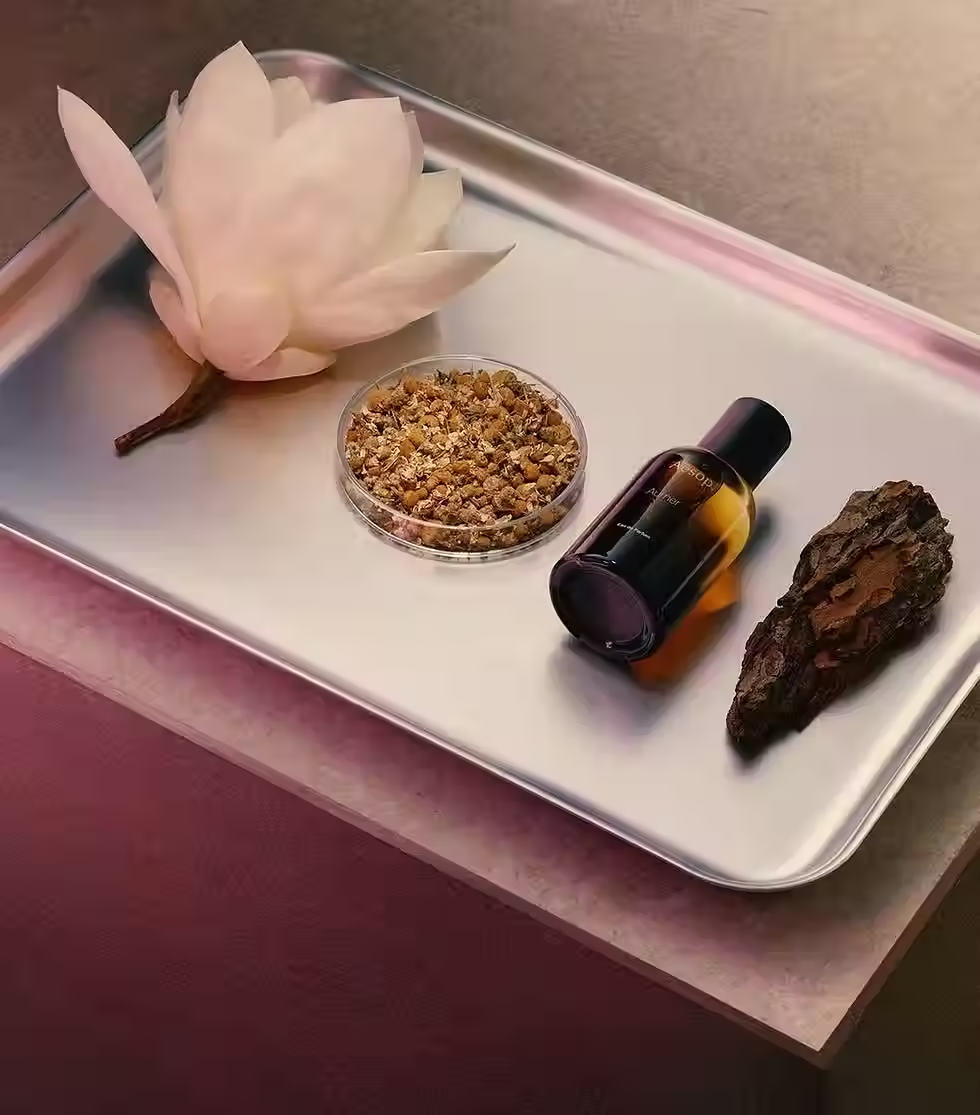
The content trap
Here is what the data looks like from the outside. TikTok sold over 370 million beauty units globally in 2024, with health and beauty accounting for nearly 80% of U.S. TikTok Shop sales, over $1.3 billion. Influencer-led discovery still moves product. The platform is a genuine conversion engine, not just a discovery one.
And here is what the data looks like from the inside, if you're honest about it. According to McKinsey's State of Beauty 2025 report, the share of consumers who look to influencers for beauty ideas dropped from 33% to 25% across the U.S., China, and Europe in just two years. Only 7% of consumers across Europe and the U.S. now cite social media influencers as a primary driver of purchase. Marketing costs have surged.
AI-generated traffic bots now constitute more than half of all web traffic, compressing the returns on paid reach. The playbook that worked in 2020 is producing diminishing returns in 2025, and the brands that scaled hardest on that playbook are feeling it most acutely.

The more interesting problem, though, is not ROI. It is identity.
When you build your brand on the back of trend cycles, posting to the algorithm's appetite, pivoting to whatever aesthetic is gaining traction, chasing the sounds and the formats and the "moments", you outsource your identity to a platform that has no loyalty to you. The algorithm is not your brand strategist. It is a river. And rivers change course.
Aesop never went in. Not because it was naive about digital reach, but because it understood something most scaling founders do not: participation in a culture is not the same as owning one.
What Aesop actually built (and what most brands miss)
The conventional reading of Aesop is that it succeeded by being aesthetic. Beautiful packaging, beautiful stores, a kind of apothecary gravity that makes you feel more considered just by holding the bottle. This reading is true and also entirely insufficient.
What Aesop built, and this is the part that matters strategically, is a cultural code. The founder, Dennis Paphitis, made a single declarative choice early on: we will own intellectual minimalism and ritualistic experience. Not luxury skincare. Not natural beauty. Not Australian heritage. Intellectual minimalism.
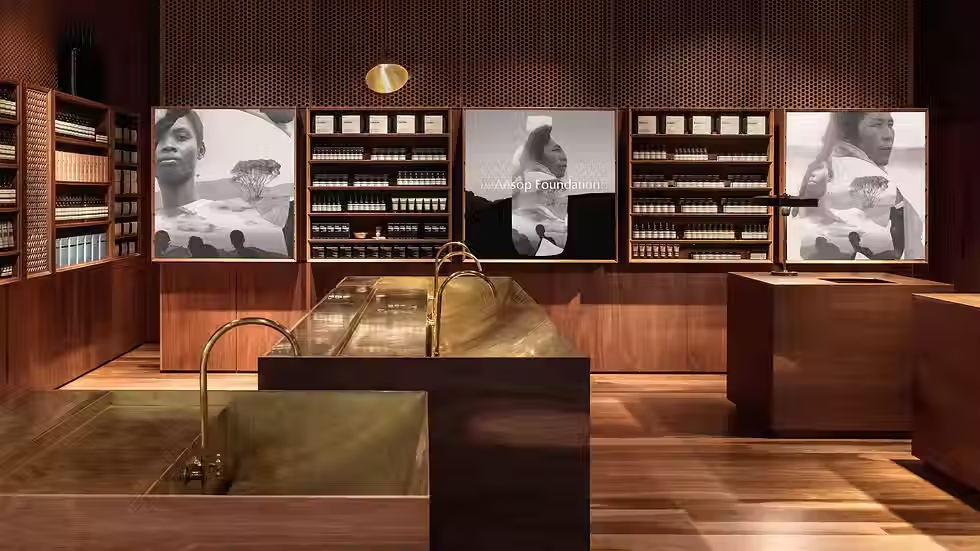
That one decision, precise, committed, almost stubbornly narrow, then determined everything else. The product names reference botanicals without emotional language. No "glow." No "transform." No "miracle." The Parsley Seed Anti-Oxidant Serum is named like a laboratory notation, not a promise. The stores are designed with local architects using local materials, Norwegian slate in Oslo, reclaimed New York Times copies in Grand Central, coconut husk string in Singapore. They don't import an aesthetic; they earn belonging by speaking the architectural language of each place.
And crucially: the brand quotes Seneca on its packaging. Proust in its newsletters. It treats its customer not as someone who needs to become something, but as someone who already is something, and is simply finding the ritual that confirms it.
The brand doesn’t make you feel like you need to become someone. It reflects who you already are.
This is a fundamentally different psychological contract than almost every other beauty brand operates on. The industry's default is aspiration: buy this, become that. Aesop inverted it. Its implicit message is recognition: you are already someone who values depth and consideration. Here is the object that belongs in your life.
For a scaling brand, the question this raises is uncomfortable: what is the cultural code your brand owns? Not your aesthetic. Not your tone of voice. Not the font on your packaging. What is the precise intersection of identity and worldview that your brand holds, and holds exclusively? If you cannot name it in a single sentence, not a paragraph, a sentence, you do not yet have a cultural code. You have a mood board.
The problem with quiet luxury (and what comes after it)
There is a trap that many scaling wellness and beauty brands fell into between 2022 and 2025, and it is worth naming directly: they mistook quiet luxury for an anti-brand strategy, when in fact it was simply another trend.

The quiet luxury movement, characterised by muted palettes, minimal branding, heritage materials, and what might be called "Succession chic", became one of the most copied aesthetics in the beauty and wellness space. Brands rebranded toward beige. They removed loud logos. They invested in amber glass and linen packaging. And within eighteen months, the visual landscape was saturated with brands that all whispered exactly the same thing.
Minimalism, when adopted as an aesthetic strategy rather than a philosophical one, becomes indistinguishable from every other minimalism. What made Aesop's restraint meaningful was not the restraint itself; it was the specific, consistent conviction behind it. The brand's silence was not the absence of something to say. It was a deliberate refusal to compete on the industry's terms.
There is an important distinction here for founders: the anti-brand strategy is not anti-marketing. It is anti-noise. Aesop is meticulous in its communication; it simply communicates through form, ritual, and material rather than through a campaign. Its most powerful marketing tool is its retail environment, where every customer is offered a hand-washing experience that is, functionally, a full sensory brand introduction. The store is not a place to buy things. It is a story you enter.
What comes after quiet luxury is not loud luxury. The data suggests something more nuanced: consumers, particularly the discerning, values-driven buyers that premium beauty and wellness brands covet, are moving toward what might be called considered conviction. They want brands that have a clear, specific point of view, communicated through actions rather than declarations. The pendulum is not swinging back to maximalism. It is swinging toward authenticity of stance.
Rituals vs products: The loyalty equation
The most structurally important insight in Aesop's model, and the most underutilised by scaling brands, is the distinction between product loyalty and ritual loyalty. These are not the same thing, and they do not produce the same outcomes.
Product loyalty is transactional: the customer stays because they like the thing, and switching costs are non-trivial. It is vulnerable to dupes, to private label, to a competitor who formulates something technically similar at a lower price point. In 2024's beauty market, where "dupe culture" became an active consumer sport and value-hacking was declared the defining shopper behaviour of the year, product loyalty has never been more fragile.
Ritual loyalty is architectural. When a brand embeds itself into the rhythm of a customer's life, into the morning and evening sequences, into the way they move through their bathroom, into the sensory language of their personal time, it becomes harder to replace than any formula. This is not an accident of Aesop's success. It is the design brief.
Consider what Aesop has built around the act of washing hands. A sink at the centre of every store. A ritualised demonstration is offered to every visitor. Specific hand wash formulations with names that evoke laboratories and gardens simultaneously. The brand has transformed an unremarkable daily act into a considered moment. And once a customer has experienced that transformation, the competitive moat is not the product; it is the meaning the product carries.

For a brand in the wellness and beauty space right now, the strategic question is: what ritual does your brand own? Not a product category. A ritual. The morning sequence. The pre-sleep wind-down. The post-workout recovery moment. Ritual is where culture and commerce intersect, and it is the only place where true brand loyalty, the kind that survives dupes, recessions, and platform algorithm changes, actually lives.
The NIQ State of Beauty 2025 data underscores this urgency: the wellness and ritual-based product segment is expanding the industry's value opportunity by 64%. Half of global consumers now say regular self-care is more important to them than it was five years ago. The market is moving toward ritual. The question is whether your brand is positioned to be part of it, or merely present in it.
Ritual is where culture and commerce intersect, and the only place true brand loyalty actually lives
Social media as the enemy of anti-brand positioning
This is the part of the conversation most consultants avoid, because it costs them the client: for a certain type of brand, one that is trying to build the cultural depth that Aesop represents, aggressive social media participation is structurally incompatible with the brand strategy.
This is not an argument against having a social media presence. It is an argument against being defined by it.
Here is the mechanics of the problem. Social media platforms, and TikTok specifically, as the most powerful beauty commerce engine of the current moment, are designed for speed, novelty, and emotional volatility. Their algorithms reward content that generates immediate reaction: surprise, desire, humour, outrage. The best-performing beauty content on these platforms is transactional by nature. It says: here is a product, here is what it does, here is a creator who loves it, here is where you buy it now.
This is a legitimate and effective commercial channel. Rare Beauty built $400 million in annual revenue substantially on TikTok's infrastructure. e.l.f. Cosmetics outpaced every other top-five cosmetics brand in growth by treating social like a nimble digital creator studio, pivoting with trends weekly.
But Rare Beauty and e.l.f. are not trying to build what Aesop built. They are trying to build something different, broad, democratic, joyful, inclusive. Their social strategies are coherent with their brand architecture. The problem arises when a brand that is genuinely trying to build intellectual depth, ritualistic loyalty, and considered luxury finds itself posting three reels a week to chase the algorithm, and in doing so, training its customer to experience the brand as a content feed rather than a world.
When Bottega Veneta deleted its Instagram account in 2021 and maintained premium market positioning anyway, it was not a stunt. It was a statement about what kind of brand it intended to be. The research firm BCG subsequently documented an 18% higher customer retention rate for brands employing minimalist luxury strategies compared to their logo-centric, high-presence counterparts. Silence, done from conviction, is not the absence of strategy. It is the strategy.

For a scaling brand with five to ten years of history, the question is not whether to be on social media. The question is: which brand are you trying to build, and is your social media participation coherent with that architecture, or is it quietly eroding it?
Five strategic moves for founders building toward depth
None of what follows is a checklist. It is a set of architectural questions. The point is not to mimic Aesop; the world does not need another amber bottle brand. The point is to draw from the structural logic of what Aesop achieved and apply that logic to your own specific context, with your own specific conviction.
Choose one cultural code and commit to it absolutely. Not a positioning statement. A cultural code, the precise intersection of worldview, identity, and practice that your brand occupies and, ideally, owns. It should be specific enough to exclude most potential customers. If it appeals to everyone, it means nothing to anyone.
Invest in ritual before you invest in reach. Before you hire your next social media manager, ask yourself: what recurring moment in your customer's life does your brand genuinely belong to? Build the ritual depth first. Then decide which channels best communicate it. Never reverse this order.
Make your retail or physical experience your best marketing. A store, a pop-up, a workshop, a packaging ritual, an unboxing sequence, any touchpoint where a customer experiences your brand with their body, not just their eyes, is worth ten pieces of content. Design it with the same care you design the product.
Audit what you refuse. Aesop's identity is as much constituted by what it does not do as by what it does, no celebrity faces, no discounting, no identical stores. What is the list of things your brand has decided never to do? If that list is short or non-existent, your brand has no edges. And a brand without edges is just a product.
Build slowly enough to mean something. The pressure on scaling brands to grow faster than their culture can absorb is immense and often fatal to what made them worth scaling in the first place. The most powerful brands of the next decade will not be the ones that reached the most people fastest. They will be the ones that built something people genuinely could not replace.
The beauty and wellness industry is at an inflection point that is less about product innovation than about meaning density. The market is not short of good formulas or beautiful packaging. It is saturated with them. What it is short of is brands that know precisely what they stand for, refuse to dilute it for reach, and build customer relationships so architecturally deep that no algorithm change, no dupe campaign, and no economic pressure can dissolve them.
Aesop did not succeed by marketing better. It succeeded by building a world, with a consistent internal logic, a specific customer it respected deeply, and a refusal to compete on terms it had not set. That world, at its best, is not a brand. It is a culture. And cultures are the only thing in this industry that compound.
The question for every founder reading this is not whether to follow Aesop's playbook. It is whether you have the patience and conviction to build a culture of your own, one that does not need to shout because it has something rare enough to speak for itself.

Hi I'm Paula, founder of H&F, and I work with wellness and beauty founders in a creative partnership that sits somewhere between strategy, storytelling, and art direction. It’s not consulting in the traditional sense, and it’s not built for speed. It’s for founders who are thinking in years, not launches, and who care as much about coherence as they do about growth.
If this way of building resonates, you can learn more about how I work here.
And if you’d rather stay in the conversation, Hunter & Florence is where these ideas continue, through monthly founder conversations and reflections on building brands that refuse to be forgettable. Subscribe to stay up to date.


Comments